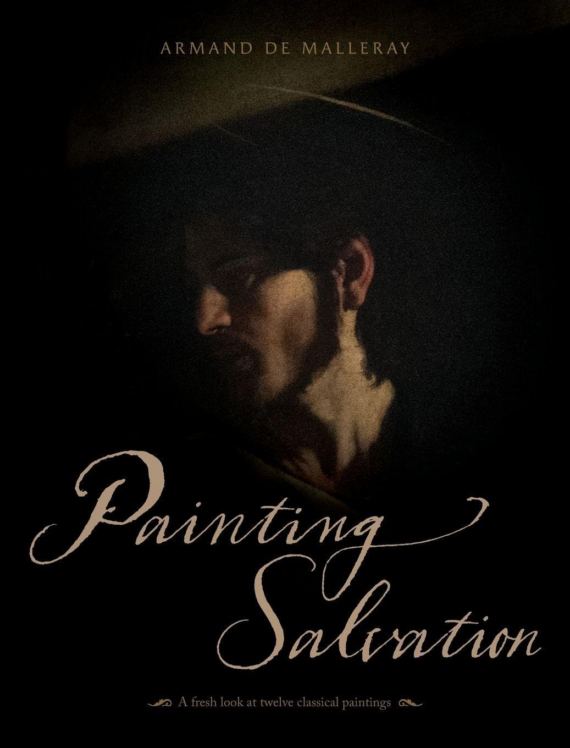
A fresh look at 12 classical paintings
ENDORSEMENTS
As with the great Cathedrals of Christendom and the Music of the Liturgy, the masterpieces of the Christian artists aid the assimilation of the truths of faith and fire the Catholic imagination. Fr de Malleray brings out in this work the importance of such images and demonstrates the fruitfulness of a proper theological engagement with them. Canon Marcus Holden, Rector of the Beda College, Rome.
A magnificent initiative to evangelise through culture and beauty. Paul Cardinal Poupard, President of the Pontifical Council for Culture
This lovely, short book encourages the reader to see all things in a more true, more sacramental light. A highly recommended spiritual work. James Gillick―renowned painter, portraitist of Pope John-Paul II and Margaret Thatcher
An enjoyable and intelligent analysis of the pictorial and spiritual “anatomies” of famous paintings we thought we knew. James Tyldesley―Artist and University Lecturer in Fine Arts, London UK
A compelling journey for both art lovers and seekers of the divine, this book reminds us that beauty and truth are eternally intertwined. Dr. Jan Christoph Bentz, Faculty of Theology and Religion, Oxford University.
REVIEW:
Rorate Caeli, on 15 April 2026.
LIST OF PAINTINGS COMMENTED:
1. Interior of the Carpenter’s Shop at Forty Hill, Enfield―John Hill
2. The Marriage of the Virgin―Raphael
3. The Adoration of the Shepherds―Georges de La Tour
4. Saint Joseph the Carpenter―Georges de La Tour
5. The Calling of Saint Matthew―Caravaggio
6. The Entombment―Michelangelo
7. Noli Me Tangere―Titian
8. The Breaking of Bread at Emmaus―Caravaggio
9. The Crucifixion of Saint Peter―Caravaggio
10. Saint Sebastian tended by Saint Irene; Synthesis―Georges de La Tour
11. Woman Holding a Balance―Vermeer
12. Seaport at Sunset―Claude
Purchase from the publisher’s website or directly on Amazon.
PRESENTATION BY THE AUTHOR:
Like sails, paintings consist of canvas stretched across perpendicular frames to reach some destination yet unseen. This book is like a sailing boat, then. Each of the twelve paintings commented upon could be seen as one of its sails. They display before our minds some limited aspect of God’s revelation: his Incarnation, his childhood, the calling of his apostles, his sacrifice, his Resurrection, and the witness of his saints. Our commentaries offer a time of contemplation, an aesthetic emotion. They seek to reveal the beating heart of famous images. If any artist is expected to help us decipher the world, even more should the Christian artist describe faithfully the Design revealed to men by God. A feast for the mind even of the unbeliever, our approach will set in motion these ingenious paintings as powerful systems of signification. These pictures move―like sails catching the wind. Land ahoy, or heaven ahead, rather, if our crossing proves to be a safe and happy one. So many images are stored in our memory, which we wish were not. Some violent, some impure; some having occurred by accident, some culpably; some naturally, some as products of technique such as cinema, videos, computer games or advertising. A good way to heal our sight is to furnish our faculties with beautiful images designed as vehicles of truth. Our memory, our imagination, our emotions subsequently use such images as safe material to cleanse and refine our outlook on the world, on people and, fundamentally, on God and eternity.
Media
The Marriage of the Virgin, by Raphael:
Italian Renaissance, Art for Souls CD-ROM (2002), conceived by Armand de Malleray and Bernard Isselin.
The Entombment, by Michelangelo:
Italian Renaissance, Art for Souls CD-ROM (2002), conceived by Armand de Malleray and Bernard Isselin.
Noli me Tangere, by Titian:
Italian Renaissance, Art for Souls CD-ROM (2002), conceived by Armand de Malleray and Bernard Isselin.
AUTHOR’S WEBSITE: malleray.com
Leave a Reply